London of Whaling Trade and Thames Whale Encounters
The WhaleLondon of Whaling Trade and Thames Whale Encounters is at once a place of personal reinvention and a city built, illuminated, and repeatedly unsettled by its relationship with whales. In Philip Hoare’s account, it is a crowded inland world that can make the sea feel both absent and overpoweringly near. Its history as a whaling port, its museums and waterfronts, and the whales that have entered the River Thames connect urban life to an ocean that resists being reduced to distance, commodity, or exhibit.
A city measured against the sea
Hoare’s relationship with the city changes over time. In his mid-twenties, living alone in London, he decided to teach himself to swim. At a chilly East End pool built between the wars, he discovered that water could support his body. The experience was not chiefly about exercise: it meant venturing beyond his depth and allowing the water to bear his presence. Learning to swim became a conscious effort to confront fears associated with childhood instruction and the institutions that swimming had come to represent for him.
Years later, London’s density began to feel oppressive. Hoare lived near the City and within sight of the Docklands, watching skyscrapers rise from the clay. In recurring dreams, water surrounded his tower block and marine animals moved below his ninth-floor home; other dreams placed animals together inside a stone-walled harbour. These images turn the city into a submerged space. The ocean is not simply outside London: in dreams it presses up against the city’s buildings and streets, making urban ground seem provisional.
The death of Hoare’s father and his mother’s life alone drew him back south more often. The return offered consolation amid grief and the loss of other emotional ties, but it also altered how he saw the familiar. He exchanged the view from his flat for daily visits to the shore, and the compressed outlook of city streets for the open horizon. Looking seaward, he watched transatlantic ships pass. The change did not erase London from his life; it made the city part of a continuing contrast between urban confinement and the expansiveness of the water.
Whaling, docks, and urban wealth
The city’s connection to whales was not only symbolic. By the 1740s, five thousand street lamps burned whale oil, making London one of the world’s best-lit cities. The capital also functioned as a whaling port. Unlike the syndicates of New England, English fleets could belong to individual merchants, and ships sailed from the Howland Great Wet Dock at Deptford, a major commercial dock able to accommodate 120 vessels. Its Arctic trade eventually gave it the name Greenland Dock. Whale bones served as quayside bollards, while try-works processed whales away from the busiest parts of the city to keep the rendering business at a distance from residents.
Whale processing also took place farther along the River Thames, at the bend where the river widens toward the sea. The site later occupied by the Millennium Dome had been used to render whales; blubber was boiled where expensive Docklands flats now stand. The changing uses of the waterfront do not cancel its industrial history. They mark a change in what the city places beside the river, while the earlier commerce remains legible in the scale and location of its docks and processing sites.
The route from whale to lamp involved work elsewhere as well as in London. On Nantucket, the manufacture of spermaceti candles began with material brought from ships to wooden manufactories. Heating, settling, and pressing separated the material into grades; repeated processing of what remained produced a pale wax. Such candles helped make whale products valuable, while the city’s lamps made their use visible in everyday urban life. The history links industrial light in London to the extraction and processing of animal materials across a wider trade.
Collections and the ordering of whales
The Natural History Museum, London gives this relationship another form: the whale becomes a specimen to be exhibited, classified, or kept in storage. Hoare approaches the museum through its monumental architecture and the animal displays within it. A century earlier, visitors entering its galleries would have encountered a sperm-whale skeleton, presented as though it were under guard. The museum’s visual arrangement could make a whale both an object of scientific attention and an imposing presence in a public building.
Behind the galleries, the collections extend beyond what visitors see. The curator Richard Sabin takes Hoare through automatic doors into a climate-controlled area of lockers and preserved cetacean material. Specimens are stored in labelled containers, while other rooms hold animals suspended in preservative. The carefully ordered collection transforms bodies into records available for comparison and study; at the same time, its restricted rooms expose the distance between public display and the less visible work of conservation and classification.
The museum’s history also includes methods of preparing specimens outside the galleries. Until shortly before the Second World War, carcasses were placed in pits of sand on the museum grounds so that rainwater could hasten decay before the skeletons were assembled for display. The process could take two years or more, and complaints about the smell eventually brought it to an end. When Hoare leaves the galleries after hours and finds the gates locked, the museum briefly becomes a place of confinement as well as preservation. Its exhibits and procedures record changing ways of making whales available to public knowledge.
Institutional attention also extended to stranded animals. In 1913 the Crown gave the Natural History Museum, London first refusal on the carcasses of royal fish, recognizing scientific as well as commercial value. The Board of Trade asked receivers of wreck to report strandings by telegraph. During the First World War, the museum’s director Sidney Harmer compiled records of whales found along the coast, including animals mistaken for military objects or caught in the hazards of wartime waters. Across the twentieth century, the museum recorded 13,000 stranded whales, though only a small number were claimed for research. The resulting record makes the coastline a map of losses as well as a source of specimens.
Whales in the River Thames
The River Thames has repeatedly brought whales into the city’s public life. In 1658, during a storm, a right whale appeared near Dagenham. Some people treated its arrival as an omen of the death of Oliver Cromwell, who died the following day. The naturalist John Evelyn recorded the crowds who came to see the animal by river, coach, horse, and on foot. He measured it at 58 feet long and described its features, turning a striking public encounter into an early record of observation. In 1721, Daniel Defoe noted that a whale bone from the animal had been fixed beside the road from London to Colchester as a monument. The event thus left both a written account and a material marker in the landscape.
In 1961, a sixteen-foot minke whale was seen as far upriver as Kew. It had apparently collided with a boat and was found on the bank. Helpers, including RSPCA inspectors and police officers, used a tarpaulin to drag it back into the water, hoping it would return to the sea. It became caught in reeds near Kew Bridge and died. Newspapers associated the animal with a nearby drowning and a separate boating incident, presenting it as though it were responsible for events around it. That reaction recalls older ideas of the whale as a portent, even as the rescue attempt reflected a different public response.
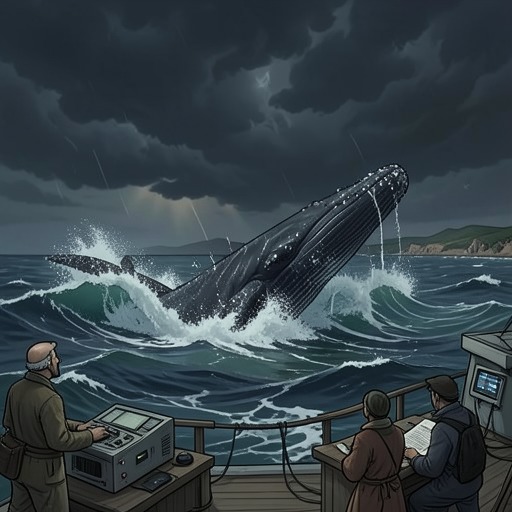
The 2006 arrival of a northern bottlenose whale made the River Thames an international stage. The animal passed under Waterloo Bridge, past Charing Cross and the Palace of Westminster, before stranding on the Battersea embankment. Crowds, boats, helicopters, and news crews converged as it moved with the tides through a river far removed from its open-sea environment. A rescue effort carried it back toward the sea on an inflated pontoon, but it died near Gravesend, short of freedom. The public response divided between praise for the attempt to help and criticism of the human pressures surrounding the animal. Its journey was treated as a national event and a possible omen, showing how readily a whale in the city becomes a focus for competing claims about human responsibility.
The city as an oceanic threshold
London of Whaling Trade and Thames Whale Encounters gathers several versions of the whale into one urban setting: fuel for street lighting, raw material processed on the river, a specimen behind museum doors, and a living animal out of place in the Thames. The city’s commercial history made whales useful at a great distance from the sea; its museums made them objects of public knowledge; its river encounters made the limits of human control newly visible.
Hoare’s personal experience gives that history a shifting scale. London can feel like a world of hard streets and pressure, yet water remains an organizing presence in his dreams, memories, and journeys back to the shore. The sea’s apparent distance from daily urban life is therefore misleading. It has supplied the city’s industries, shaped the places where ships and carcasses were handled, and entered the capital itself through repeated strandings. In this account, the city is not separate from the ocean but one of the places where its material histories and unresolved claims become visible.